
Stay in the Know - Subscribe to Our Newsletters
Join a network of more than 90,000 waste and recycling industry professionals. Get the latest news and insights straight to your inbox. Free.
The debate over the greenest way to handle organic waste — via composting or landfilling — has been heating up in recent years, and shows no signs of abating.
Organics are a hot waste and recycling commodity. And that popularity has generated a sometimes heated business, political and philosophical debate about their best end-use.
Some argue that composting food and yard waste is the clear environmental choice. “Composting is the highest and best use of these residuals,” says Stu Buckner, former executive director of the Bethesda, Md.-based U.S. Composting Council and now CEO of Buckner Environmental Associates in East Islip, N.Y.
But others contend that, at least in certain cases, putting organics in landfills that have a methane gas collection and an energy conversion system in place makes the most sense — environmentally as well as economically. “You really need to look at the situation,” says Devin Moose, a director for the Shaw Group in St. Charles, Ill. He has consulted on dozens of both composting and landfill gas-to-energy (LFTGE) projects. “You really need to look at the situation,” he says. “There are times when composting certainly makes sense. The majority of time it doesn’t make sense.”
The discussion has intensified in the political arena. More than 20 states currently have bans against disposing of organics in landfills, Buckner says. But Florida repealed its ban in 2010 and Georgia followed suit the next year. Michigan and Missouri are considering ban repeals. But conversely, he adds, Delaware recently implemented a yard waste ban. Vermont earlier this year passed a law that will ban all organics from its landfills by 2020, and Massachusetts is considering an organics ban beginning in 2014.
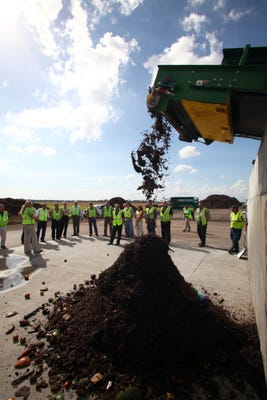 Buckner says the waste management companies are working to repeal the bans because they want more tip fees. Houston-based Waste Management Inc. is invested significantly in both LFGTE and organics recycling. Company officials take issue with being labeled as an advocate for organics in landfills. “We’re really focused on finding the highest and best use out of all the materials we manage,” says Eric Myers, director of organic recycling for the company. “A lot of folks are misconstruing what we’re doing.” He argues that Waste Management isn’t against landfill bans so much as a ban without a plan. “Some states with landfill bans have horrid management because the regulatory structure isn’t there.”
The success or failure of organics landfill bans can depend largely on the economics and demographics of the area, says Dan Jameson, vice president, municipal services and government affairs, for Phoenix-based Republic Services Inc., another company with a large stake both in LFGTE and organics recycling. Composting advocates claim that landfill operators need the organics for sufficient methane generation, but Jameson says Republic didn’t see huge volume growth at its sites in Georgia after the state repealed its organics ban. “We haven’t made a conscious decision to politically push [repealing landfill bans],” he says. “I’m not a big advocate of putting grass back in landfills to improve methane quality.”
Still, he acknowledges the difference with organics for landfill gas projects can add up over time. “If we measure short term it won’t be as comprehensive as it would be over five to 10 years on the impact on the landfill.”
And the waste volumes at stake for both landfills and composters make it quite attractive. The U.S. Environmental Protection Agency (EPA) reported in its municipal solid waste (MSW) generation study for 2010 that food scraps totaled 34,760 million* tons, or 13.9 percent of the waste stream. Yard trimmings amounted to 33,400 million* tons, or 13.4 percent of MSW. More than half (19,200 million* tons) of the yard trimmings were recycled, the EPA reported, but only a small amount (970,000** tons, or 3 percent) of the food scraps wound up outside a landfill.
The EPA’s landfill methane outreach program (LMOP) database, as of June 1 accounts for 594 operational LFGTE projects in the United States, and 438 of those generate a total of 1,800 megawatts of electricity. The potential exists for that number to nearly double. The LMOP database identifies 545 landfills that may be good candidates for LFGTE. The EPA estimates those sites in total could generate about 1,200 megawatts of electricity.
Waste Management alone operates 131 LFGTE facilities at its 266 landfills, says Wes Muir, director of corporate communications for the company.
The EPA’s position on organics is that under ideal conditions, composting is preferable to landfilling. “For waste that cannot be composted, energy recovery offers the next best option,” said Stacy Kika, office of media relations for the EPA, in an e-mail response.
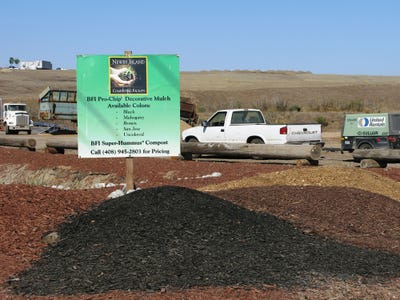 And that is where Buckner’s arguments for composting over landfilling begin. “Landfilling organics is contrary to national policy,” he says. “The EPA’s recycling goal can’t be achieved without increasing the amount of organics being recycled.” It’s also contrary to the policy of the Solid Waste Association of North America (SWANA) and the Composting Council. (The current director of the Composting Council, Michael Virga, was unavailable to discuss the issue for this article.)
A big argument for composting advocates is that landfilling organics increases greenhouse gas (GHG) emissions. No matter how good the landfill gas collection system is, Buckner argues, at least 25 percent of the methane will escape — and it could be as high as 80 percent. GHG emissions are negligible from composting, he says, while landfills contribute 34 percent of all man-made methane emissions in the United States. Composting minimizes methane generation. It produces carbon dioxide, which doesn’t count in the government’s greenhouse gas calculation.
Composting is a better use of organics, as it reuses the material into soil amendments, which helps the productivity of the soil. And diverting organics from landfills is consistent with many states’ diversion goals, particularly with more cities establishing zero waste goals. “These state goals can’t be achieved without recycling increases of organics,” Buckner says.
Energy production from landfill gas is a minor and poor performing source, he argues, and an anaerobic digester to extract the energy component of organics is much more efficient. Organics degrade so quickly that emissions are occurring before they can be captured by a LFGTE system.
Pollution can become an issue at landfills, with the potential of leachate leaks requiring groundwater monitoring for years after closure and possible remediation, which can result in significant costs as well as environmental damage.
Also, economically, studies have estimated that recycling creates four jobs for every one at a landfill.
Finally, composting turns waste into products with many uses. “Landfills are simply an inefficient way to use organics; it wastes resources,” Buckner says.
Organics bans have significantly helped composting. The number of composting facilities has climbed from about 650 in 1988 to more than 3,500 by 2010, he says. But while bans are effective, “there are other means of getting at the same objective, which is to get organics out of landfills.”
But waste and recycling consultant Moose tends to see LFGTE as the better choice for organics, citing transportation as a key factor. Organics often have to travel long distances to remote composting facilities. “The driving trips; it’ll lose every time when it comes to the environment.”
Moose cites a 2008 study of greenhouse gas emissions from composted and landfilled yard waste in the city of Des Moines, Iowa, by the Roseville, Minn.-based engineering and design firm Sebesta Blomberg. The report concludes: “The collection of landfill gas and generation of electricity from those renewable gases leads to more than three times the amount of greenhouse gas emission reductions than does the composting operation.” The report adds that landfills have reduced emissions by 75 percent since the 1970s.
There also are various air emission issues, he says, in the majority of com- posting windrow facilities. A 2007 study by the Cornell University Waste Management Institute chronicled literature examining those concerns, such as higher bioaerosols and organic dust.
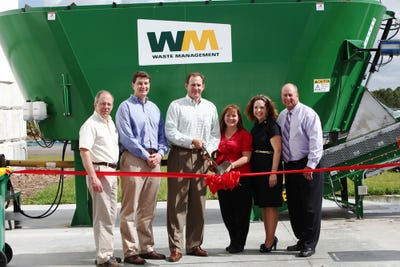 With organics in landfills, Moose says, there are no toxicity issues. Because yard waste decomposes relatively quickly there’s not a leachate problem. He insists that landfills are safer than composting operations. Moreover, he says, much more methane is captured at landfills than at compost operations. “Any science-based person would argue that with adding landscape waste to the landfill there’s no measurable increased threat to environment.”
He believes history has a lot to do with the resistance to organics in landfills. In the 1990s there were concerns about a scarcity of landfill space, and pulling landscape waste out removed a big chunk of the volume. “That issue doesn’t exist today,” Moose points out.
He sees it to a large extent as a political issue. “If you take landscape waste out people’s recycling rates would be cut in half,” Moose says. “That’s very hard for elected officials to explain. Right now everyone is trying to beat the next person [with a bigger diversion rate].”
Cost also is a factor, Moose argues. Commingling organics with other waste into a landfill saves a lot of money. “My municipal clients are all worried about money, they’re all pushed,” he says. “Volumes are down, they’re trying to find ways to make that up.
“Absolute bans take away the ability to apply science and logic to a local setting,” Moose says.
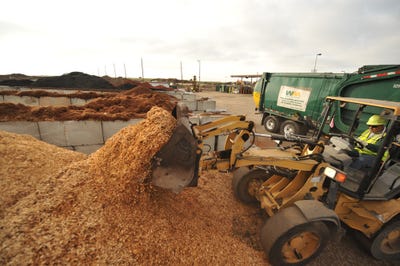 Waste Management points to Florida as a case study for its approach to the organics issue. The state had a landfill ban on organics for 15 years. Myers says Florida annually generated 3.4 million tons of yard waste, but only 1.5 million tons were beneficially used. The majority went into construction and demolition (C&D) landfills or “grind and shoot” operations that spread it on land. The state approved a law that allows for organics in landfills that have systems for methane capture. “It made sense locally and was approved virtually unanimously,” he says.
Conversely, Seattle worked for years to put organics recycling programs in place first before it banned yard waste from landfills. “States that are doing it well plan first and then put a ban in place,” he says. “It’s easy to put a ban in place; the heavy lifting is to develop the programs.”
Waste Management says it even is working with the Composting Council to pursue practical legislation elsewhere.
At the same time, Waste Management has built two state-of-the-art composting facilities in Florida. And it has built six overall in recent years. The company has made major investments in organics operations with operations including the Waltham, Mass.-based Harvest Power and the recently purchased Cleveland-based Garrick LLC. It has developed new technologies for organics recycling. “Our focus is really in transferring organics into higher value products,” he says.
Muir adds, “We support organics recycling, but where we do not have access to organics facilities, we think it can be put in a landfill where it can be decomposed and converted to a clean energy source.”
Republic’s Jameson agrees. “We’re looking for the best solution for community as well as what’s best for the marketplace.”
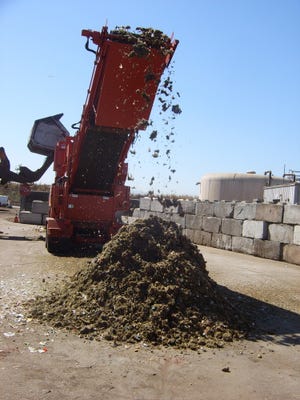 Having adequate markets for com- posting can be an issue. “There’s only so many markets for that kind of stuff,” Jameson says. “You can have composting sites everywhere. It has to make viable economic sense for everybody involved.”
Buckner says while the cost of landfilling is lower in some parts of the country it’s higher than composting costs in others, making composting an economically more attractive choice. But it should be about more than costs. “Composting is the right thing to do,” he says. “It’s the best management for organics. It’s about environmental protection, environmental sustainability.”
Moose recommends approaching the issue without preconceptions. “The industry ought to slow down, take a look at what makes sense for the environment and become more sophisticated in its analysis versus ‘just don’t put it in the landfill,’” he says. And the public needs to be better educated about the issue as well: “There’s just a genuine lack of understanding of what’s good for the environment. Everybody wants to distill it to the 3R’s [reduce, reuse, recycle].”
In the end, both composting and landfilling of organics won’t answer every question. “I don’t think either one is the panacea,” Jameson says.
Allan Gerlat is news editor for Waste Age and waste360.com.
* CORRECTION: The original version of this story incorrectly stated these figures from EPA's 2010 municipal solid waste generation study in thousands of tons.
** CORRECTION: The original version of this story incorrectly stated this figure from EPA's 2010 municipal solid waste generation study in hundreds of tons.
You May Also Like