
Stay in the Know - Subscribe to Our Newsletters
Join a network of more than 90,000 waste and recycling industry professionals. Get the latest news and insights straight to your inbox. Free.
How the destruction and debris left behind by Superstorm Sandy forced waste handlers in New York and New Jersey to rethink their entire operations.

John Doherty, New York Department of Sanitation’s 74-year-old commissioner, has lived his whole life in New York City and has worked for the department for more than 50 years. But last fall’s historic Superstorm Sandy made an impression on even this seasoned veteran.
“This was the worst natural disaster I’ve seen in my lifetime as a New Yorker,” Doherty says. “Nobody anticipated we’d see anything like this.”
The storm hit the entire eastern seaboard of the United States in late October but did the most severe damage to the heavily populated areas of New York City and New Jersey. Damage estimates in the United States exceed $60 billion.
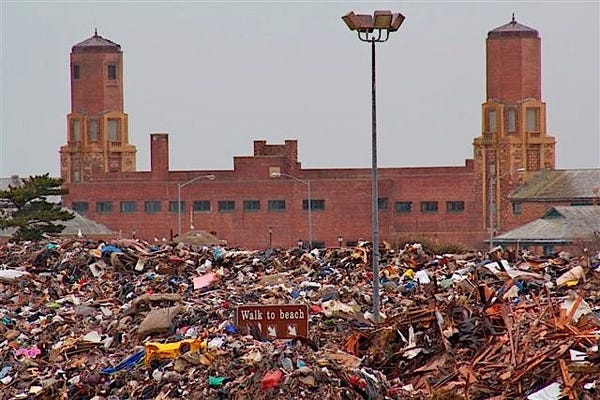 Moreover, it left an enormous amount of waste debris to be managed. Doherty says the Department of Sanitation (DSNY) has collected 390,000 tons of debris caused by Sandy, and expects that figure to exceed 400,000 tons before they’re done. In Atlantic City workers gathered more than 4,500 tons, says Paul Jerkins, public works director for the city. In New Jersey the Federal Emergency Management Agency (FEMA) put the overall debris estimate at 6.5 million cubic yards, a figure that might be soft due to massive tree damage in the northern part of the state, says Larry Ragonese, press director for the New Jersey Department of Environmental Protection (NJDEP).
“There was more vegetative waste in one day than there usually is in a year,” he says. “We’ve never seen anything like that. It looks like a giant just uprooted the trees.”
The U.S. Army Corps of Engineers, which assists FEMA in emergency response, reports that according to the U.S. Environmental Protection Agency (EPA) nearly 115,000 individual containers of household hazardous waste was collected overall, and about 400,000 cubic yards of vegetative debris, about two-thirds of which has been chipped for beneficial reuse, says Craig Coombs, environmental engineer with the Army Corps.
“It was an event we had prepared for, but you couldn’t prepare for it,” Ragonese says.
Doherty said in January that the bulk of the cleanup was done in New York City. But residents and businesses are doing ongoing renovation as a result of the storm, which means more waste generation. He expected the cleanup to take another month.
In Atlantic City Jerkins is seeing much the same situation. They’re still picking up household debris in areas that were submerged under three and a half to four feet of water. The primary tourist areas represented by the boardwalk and the casinos weren’t impacted, but a more remote stretch of the boardwalk that was damaged still needs to be cleaned up.
Ragonese says NJDEP anticipated that debris from the storm would be a major problem. “Unfortunately, our prediction came true, because the amount of debris was enormous,” the most in at least a half a century for the area, he adds.
Because it knew the state needed help, NJDEP connected with major debris haulers across the country who had experience in disaster management and arranged state contracts, so any organization could use their services with having to go through the bidding process.
 NJDEP also realized much of the debris would need to be disposed in out-of-state landfills because of the volume. So it helped set up as many as 250 temporary disposal areas around the state, from unused parking lots to closed landfills. “We wanted to get the health and safety concerns off the streets to give the people in that town a fighting chance to deal with the tragedy that occurred,” Ragonese says.
The department also assigned a person to every town that had storm damage. “We left nothing to chance so people were able to connect directly with contractors, haulers, recyclers, town officials,” he says.
Jerkins says for Atlantic City, because the storm was unprecedented, “There wasn’t a real plan of cleanup or attack. Everything had to be put together at the time of the storm.” The NJDEP temporary disposal sites “helped us tremendously,” he says, because everyone was dumping debris at the landfill, and trucks were backed up for hours.
“Just so much of it was just getting it off the streets,” says Jerkins. “It was so bad it looked like the city had been bombed. When people were allowed to go back into their homes they set debris out on sidewalks and then the street. Some streets were impassible, with mounds 10 to 12 feet high.” Disabled vehicles also blocked the streets.
Jerkins’ department struggled to come up with a routine to service the entire city. FEMA reimburses 75 percent of the cost of disaster cleanup, but Atlantic City wasn’t financially able to pay contractors up front. So for the most part, the public works department did the work itself, at one-third of what it would have normally cost.
The city established a rotation plan after the first week. Perhaps predictably, Jerkins says initially everyone thought that they should be the priority. Nevertheless, “by the end of second week most all of our citizens understood and worked with us pretty good and kept debris out of streets.”
For DSNY, its plan going in was similar to a snow removal operation, only with debris playing the part of the snow. “First you have to open up blocks immediately so rescue and emergency equipment and the needed help can get to the affected areas,” Doherty says. “And that went pretty quickly.”
New York City also used temporary debris storage areas, from a federal park area to some locations on Staten Island to parking lots and beach areas — even the old Fresh Kills landfill. Everything along the waterfront, including the DSNY recyclers, was temporarily shut down by the storm. Also, some of the rail lines used for waste removal had been compromised. “We were nip and tuck every day trying to find an outlet for the garbage,” Doherty says. “We were able to do it through emergency contracts.”
Doherty says the Army Corps of Engineers and FEMA, both based in Washington, were helpful in debris removal. “It took a couple weeks for them to get on board, but once they were handling that debris it made it a lot easier because there was more room to pick up what people were throwing out. If we didn’t have that the whole system would have fallen apart.”
For Jerkins, FEMA primarily supplied information on how to respond. And the city will be submitting its costs to FEMA for reimbursement, although FEMA will have to pay less because the city did it for less.
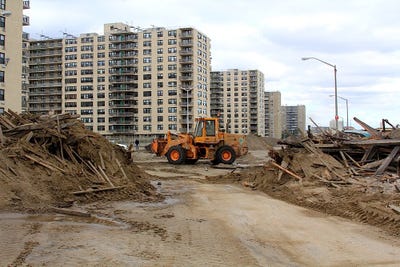 Coombs said in e-mail response that a particular challenge for the Army Corps was both the density of people and the tight spaces where the work needed to be done, particularly in New York City.
Another unique problem, he said, was the presence of the Asian long-horned beetle in the vegetative waste. That limited potential outlets for that vegetative debris, as officials didn’t want to contribute to the spread of the insect.
New York City had to suspend recycling for about two and a half weeks while crews focused on getting all the debris collected. “Nobody really complained, they left it at the curb,” Doherty says. “We tried to avoid mixing it in with the regular garbage. You do see some loss but all in all we did pretty well.”
DSNY crews are equipped to remove refrigerants, so white goods could be recycled as well, and that went better than Doherty expected.
Regular trash pickup stayed pretty well on schedule. “The first week we were a little behind because of the storm debris,” he says. “After the first weekend we worked seven days a week around the clock until we caught up.”
In Atlantic City Jerkins says the city Utility Authority normally does its recycling. But with the storm all public work crews were combined to pick up all materials and recycle what they could. “I know they did a fantastic job,” he says. “People weren’t really concerned about trying to separate for recycling at the height of this thing.”
In New York City the snow removal game plan calls for open dump trucks and front-loading vehicles to haul for short dumps. With Sandy DSNY used the rear-loading vehicles. “That worked out well for us,” he says. The trucks carry 10 to 12 tons compared with 3.5 tons on the dump trucks. “We could keep personnel on the street for a longer period of time.” The front loaders also gave the department the ability to use buckets, which helped in the collection of loose debris.
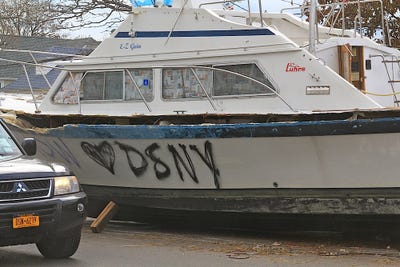
In New Jersey the next big phase of the cleanup involves abandoned vessels on the state’s waterways. There were about 1,400 identified immediately after the storm. About 400 to 500 still remain. The state will hire one or more contractors to manage the waterway debris. “We’d like to get as much out of waterway by the summer season as we can,” Ragonese says.
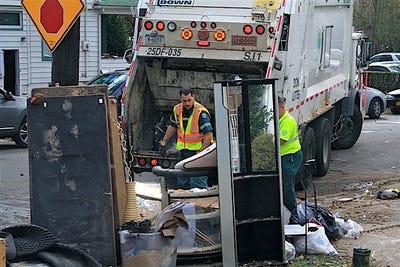 Jerkins says that in preparation for the next big storm the city will set up a plan with contractors so that they are ready to supply equipment or services without having to go through red tape, and the government will put money in the budget for it if and when it’s needed, and for emergency seasonal workers as well.
Coombs with the Army Corps says communicating and developing relationships with local officials is highly valuable ahead of disasters like Sandy.
Meanwhile, planners need to rethink the design of cities, says Doherty, such as where utilities are placed and whether more berms are needed along beaches. In terms of waste management, the city will look to identify locations for additional disposal capacity in emergency situations.
The best way to avoid this kind of chaos? “Don’t have any storms,” Ragonese quips, adding with seriousness that responding quickly is key. But it’s also essential for local governments to document what’s picked up so they can be reimbursed. “And you’ve got to make sure you protect your environment,” he says. “You can’t be casual on that.”
Finally, don’t underestimate the size of the task in front of you, Ragonese warns: “Frankly, you take a giant gulp: ‘What are we going to do?’ You try to break it down into bite-sized pieces. That’s how we tackled it.”
And as with so many disasters before it, the damage from Sandy was often personal for the workers. “They might have to clean up family albums that are part of the lives of their friends,” Doherty says. And the workers might be dealing with their own property damage as well.
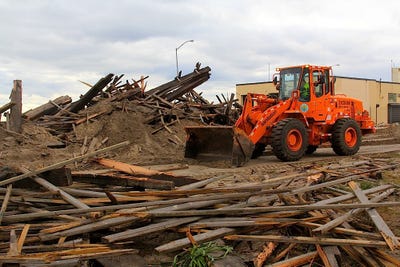 A point of pride for Doherty was that despite the stress and hazards posed by the cleanup, there were very few injuries for the DSNY. This despite a grueling work marathon coinciding with the holidays. The workers’ first day off was Thanksgiving; the next was Christmas. He praises his staff for their work.
“It’s really a morale builder for the men,” says Doherty. “It’s a mundane job most of the time. They got an opportunity to do something that will affect people they know.”
The departments themselves now have a greater understanding of what to do. “It’s been a learning experience,” Jerkins says. “I think we’ve done some things right, and some things we could have done better. But how would you know until you go through it?”
“You want to get the neighborhood back as normal as possible,” Doherty says. “You don’t want people going back and forth and looking at the debris. I think it just adds to the problem and the concerns of people. I think once you clean it up and get your streets to look a little better people’s attitude changes; it gets a little bit better.”
Allan Gerlat is News Editor for Waste Age and waste360.com.
You May Also Like